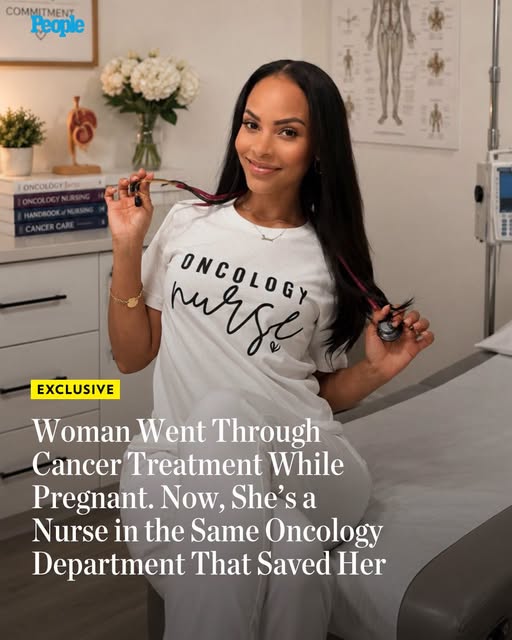
Woman Went Through Cancer Treatment While Pregnant. Now, She’s a Nurse in the Same Oncology Department That Saved Her (Exclusive)
Alicia Harris has been sharing her story of survivorship online
- Alicia Harris was diagnosed with invasive ductal carcinoma at 14 weeks pregnant
- She sought another medical opinion and welcomed her daughter, Journi, at 36 weeks
- Harris founded Journi for Two to support pregnant women facing cancer diagnoses
-
When Alicia Henry Harris went in for a routine checkup in 2021, her doctor felt something during her breast exam that gave her pause.
Given that Harris was 14 weeks pregnant at the time, she initially thought it was the milk coming in. However, Harris, now 42, still decided to get an ultrasound — only to be diagnosed with invasive ductal carcinoma.
Her doctor initially recommended that Harris terminate her pregnancy, but she wanted to understand all of her options, eventually finding another doctor who led a pregnant woman through cancer treatment.
Harris then had a lumpectomy, went through chemo during her third trimester and delivered her daughter, Journi, at 36 weeks.
-
Harris tells PEOPLE she was in treatment, which included hormone therapy, for about a year and a half.
“Having to navigate your treatment in between that and the pregnancy hormones and you feeling nauseous and you wanting to eat and all of the things, and this should be a time that you should really be excited and happy, it was just hard to do that with this diagnosis over my head,” she admits. “I noticed at that time that there was something missing because I was yearning for just a more emotional connection with somebody that really understood what I was going through.”
That’s what inspired Harris to start her foundation, Journi for Two, a nonprofit organization dedicated to pregnant women with cancer.
“At that time, I was like, ‘I wanna start a nonprofit to be able to help other mothers through this because I don’t think I want anybody to feel what I was feeling at that time,’” she shares.
“Survivorship is a time … that’s the quiet part that most people don’t talk about. After treatment, there is a lot more that goes on. After you ring the bell, that’s only the beginning of something that’s a lot longer. Survivorship is forever,” she shared.
Even while “helping others,” Harris notes that she “still felt alone.”
“Nobody really understands what survivorship is, because you really lose a part of yourself after all of that. Going through treatment and having to go through postpartum while having radiation and while doing treatment was just a hard time, really hard time,” Harris shares.
-
After such a life-altering experience, Harris says her “whole purpose changed” and she “wanted to be more hands-on” and connected with other women going through the same thing. So, Harris decided to become an oncology nurse — with her goal to end up in the same hospital where she received treatment.
“Because of the treatment that I got with my care team and the collaboration with how everything turned out, and my daughter’s here and healthy, and I wanted to be more hands-on,” she explains.
Harris went back to school at 40, but admits it “was a hard time.”
“I had imposter syndrome because I was struggling with survivorship. I just didn’t even think that I was capable of doing it, but I actually did it,” she shares. “Now, I’m working in the same oncology unit where I was a patient. Before that, I was in the beauty industry, and I was doing that for over 20 years. Going from beauty to nursing was like learning a different language.”
After her diagnosis, she had a different outlook on life, realizing life is short and hoping to make sure whatever she did with her time had the biggest impact.
-
“I don’t always want to be strong. Sometimes I need support. Sometimes I need somebody there for me,” she says. “To now have that sisterhood, those resources, and not only for myself, but I can share those resources now with the others that I’m helping with the oncology unit and my nonprofit.”
Now, as a nurse, she is open with her patients about her own story, letting them know that while every diagnosis and journey is different, they’re not alone.
“I had a nurse that told me the same thing during my first appointment, and she held my hand, and she told me, ‘Listen, it’s gonna be okay. I was once in your shoes, and look at where I am today,’ ” she recalls.
- While having a firsthand experience can make the job more emotionally taxing at times — especially when walking into the same rooms where she has so many difficult memories — she finds the work “so fulfilling.”
-
So many nurses became bright lights for her during an otherwise dark time, and she is “so glad” to carry that on for other patients.
Harris has been able to share her survivorship story through AboutDamnTime.com, a hub for educational resources, real-life stories and practical tools to help women understand the long-term treatment phase and management of early breast cancer treatment.
“Even if it’s one person that comes up to me and says, ‘Wow, I’m going through this. You really helped me,’ or ‘Now I’m gonna go get checked for this, or now because of you I’m gonna go seek other opinions on my situation,’ I feel like it makes it all worthwhile sharing my story,” she tells PEOPLE.
“I know some people are like, ‘Is this something you’re gonna talk about forever?’ It’s a part of my life forever, and if I can share it and help somebody, I will share it,” she adds.
This is Harris’ personal story and is not medical advice. Every person with breast cancer should work with their care team to understand their individual risks and treatment options.