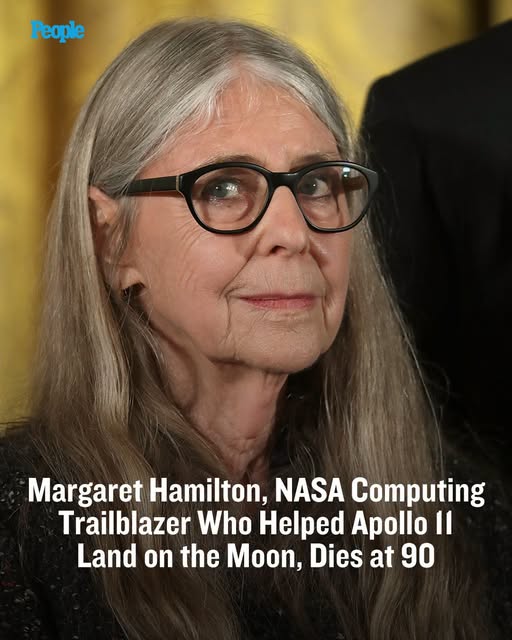
Margaret Hamilton, NASA Computing Trailblazer Who Helped Apollo 11 Land on the Moon, Dies at 90
The scientist led the software engineering team at MIT during the Apollo program and was awarded the Presidential Medal of Freedom by Barack Obama in 2016
- Margaret Hamilton died on Wednesday, Sept. 30, at the age of 90
- The pioneering computer scientist led the software engineering team at MIT during the Apollo program that landed humans on the moon
- She authored more than 130 publications, became a CEO and entrepreneur and was awarded the Presidential Medal of Freedom by Barack Obama in 2016
Margaret Hamilton, the pioneering computer scientist whose software helped NASA launch Apollo 11 to the moon, has died. She was 90.
She died on Wednesday, Sept. 30, the Massachusetts Institute of Technology announced in a news release. No cause of death has been shared.
Hugely influential in establishing software engineering as a dedicated field, Hamilton led the team at MIT’s Instrumentation Lab during the Apollo program that landed 12 people on the moon between 1969 and 1972, the university wrote.
“I was attracted both by the sheer idea and the fact that it had never been done before. I was the first programmer to join and the first woman they hired,” she told The Guardian in 2019.
Hamilton was born in Paoli, Ind., in 1936, and began studying math at the University of Michigan in 1955 before moving to Earlham College, where she majored in math with a minor in philosophy, per the MIT release.
In 1959, she moved to Boston with her then-husband, James Cox Hamilton, and began working at MIT, originally on a temporary basis.
Six years later, she applied to develop software to “send man to the moon” at MIT’s Instrumentation Lab after her husband saw an advertisement in the newspaper.
She was hired as the first programmer for the Apollo project, and by 1968, the year before Neil Armstrong and Buzz Aldrin made history by becoming the first people to set foot on the moon, she was assistant director in charge of the Command and Service Module team.
“From my own perspective, the software experience itself (designing it, developing it, evolving it, watching it perform and learning from it for future systems) was at least as exciting as the events surrounding the mission,” she told MIT News in 2009. “Looking back, we were the luckiest people in the world; there was no choice but to be pioneers.”
Hamilton left MIT in the mid-1970s and authored 130 publications across her career, later becoming a computing entrepreneur and CEO — she founded Higher Order Software and Hamilton Technologies — working to promote software engineering as its own discipline, per the university.
I fought to bring the software legitimacy so that it — and those building it — would be given its due respect, and thus I began to use the term ‘software engineering’ to distinguish it from hardware and other kinds of engineering,” she told Spanish newspaper El País in 2018.
“When I first started using this phrase, it was considered to be quite amusing. It was an ongoing joke for a long time. They liked to kid me about my radical ideas,” she said. “Software eventually and necessarily gained the same respect as any other discipline.”
In 2016, she was awarded the Presidential Medal of Freedom by then-President Barack Obama.
“Luckily for us, Margaret never stopped pioneering,” Obama said at the presentation. “She symbolizes the generation of unsung women who helped send humankind into space. Her software architecture echoes in countless technologies today.”
“Her example speaks of the American spirit of discovery that exists in every little girl and little boy who know that somehow, to look beyond the heavens is to look deep within ourselves, and to figure out just what is possible,” he continued.
Over the years, Hamilton also earned the NASA Exceptional Space Act Award, the Computer History Museum Fellow Award and the Intrepid Lifetime Achievement Award. In addition, she was a member of the National Aviation Hall of Fame, MIT said.
Hamilton is survived by her daughter, Lauren Hamilton; her son-in-law, Richard Selesnick; two grandsons; four great-grandchildren; and her siblings John, David and Kathryn.
LEAVE A COMMENT