I want to start with who Leo is on his best days, because the best days are the context for everything that followed and because it would be easy to tell this story in a way that makes him a villain, and he is not a villain. He is fourteen and he is mine and both of those things require saying clearly before anything else.
Leo has been a reader since he was four. He reads the way some children play sports, with his whole body involved, hunched over the book with his knees up and his feet tucked in, rereading favorite passages the way athletes replay their best moments. He has opinions about books that are serious and specific, not the performed opinions of a child who wants to seem mature but the genuine ones of someone who has thought about something and arrived at a position. He told me once, when he was eleven, that he felt sorry for people who didn’t read for pleasure, because they were going through life without the tool for it.
He is funny in the precise way, the kind of humor that requires paying attention to find. He does not perform jokes. He makes observations and lets them land without announcing that they have landed, which is a more sophisticated comic sensibility than most adults ever develop.
He has, since he was small, been the child at birthday parties who goes to sit with the kid who is sitting alone. I have watched this happen at six different birthday parties across eight years, the particular moment when the social geography of a children’s event becomes visible and Leo quietly positions himself next to the person who needs it. I have never said anything to him about this. I have never pointed it out afterward or praised him for it. It is simply a thing he does because it is who he is.
I am telling you all of this because I stood in a restaurant and looked at my son making fun of a human being who was doing his job carefully and with dignity, and I did not recognize what I was seeing. Not because it was impossible to believe, but because it was such a departure from the Leo I knew that I had to hold both things at the same time, the boy who sat with the lonely kid at birthday parties and the boy who pulled his shoulders forward and tilted his head to mimic a stranger’s disability.
Both were my son.
This is the thing that parents are not always prepared for.
His name is Leo, and he is fourteen, and he is growing into something that is not yet finished, and in that unfinished state he is capable of things that he would not have been capable of at nine and that I hope he will not be capable of at twenty-five, and the job I have right now is to contribute something to that becoming, which is the job I have always had and which never stops being complicated.
My name is Ellen. I am forty-three years old and I raised Leo mostly alone, which is a sentence that requires some explanation and some not, because mostly alone has the texture of many different things depending on which year you are in.
Leo’s father is not dead. He is in Portland, where he has been for six years, since he and I arrived at the conclusion that the marriage was not going to produce the life either of us had meant to build. The divorce was not a war. It was more like a tide going out, slow and irreversible, and we had both watched it go and then done the work of arranging what came after with the pragmatic cooperation of two people who still respected each other even though they could not be married anymore.
Leo sees his father four times a year and they have the relationship that fathers and sons develop when the contact is scheduled rather than daily, closer in some ways than it might be otherwise, more deliberate, with the specific quality of conversations that happen because someone made an effort to be there for them.
But day to day, it is me.
And day to day, I have watched Leo become who he is, have watched the reading and the humor and the particular kindness toward lonely kids at parties, and I have believed I knew what I was building toward.
The steakhouse was his idea, specifically.
He had been asking about it since April, when his friend Marcus had been taken there for his birthday and had described it with the reverence of someone reporting from a better world. Leo had a history with good restaurants, not the fancy kind but the kind where the food was taken seriously, where you could tell that what was on the plate mattered to the people who made it, and he was the child who read menus carefully and asked questions about preparation with the same seriousness he brought to books.
The report card had been worth celebrating.
He had a learning difference, Leo, a processing challenge that had made reading slow for him in the early years despite loving books fiercely, and the work he had put into the school year just finished had produced results that were genuinely his, not the results of accommodations or of teachers adjusting the bar downward, but of a boy who had worked harder than most of his classmates and achieved something real with that work.
I was proud of him in the specific way that pride works when someone you love has earned something.
We drove to the restaurant on a Friday evening in June, the particular warm and long-lit evening that makes everything feel like the right kind of occasion, and Leo was in the passenger seat doing the thing he did when he was in a good mood, which was narrating the world outside the window with a running commentary that was too quiet to fully hear but that I could catch phrases of and that always made me smile.

We were shown to a table.
The restaurant was the kind that took its food seriously but was not precious about it, the kind of place where people were there to eat and the eating was good, with the low light and the leather booths that had the quality of somewhere that had been there long enough to mean something.
Sam came to our table.
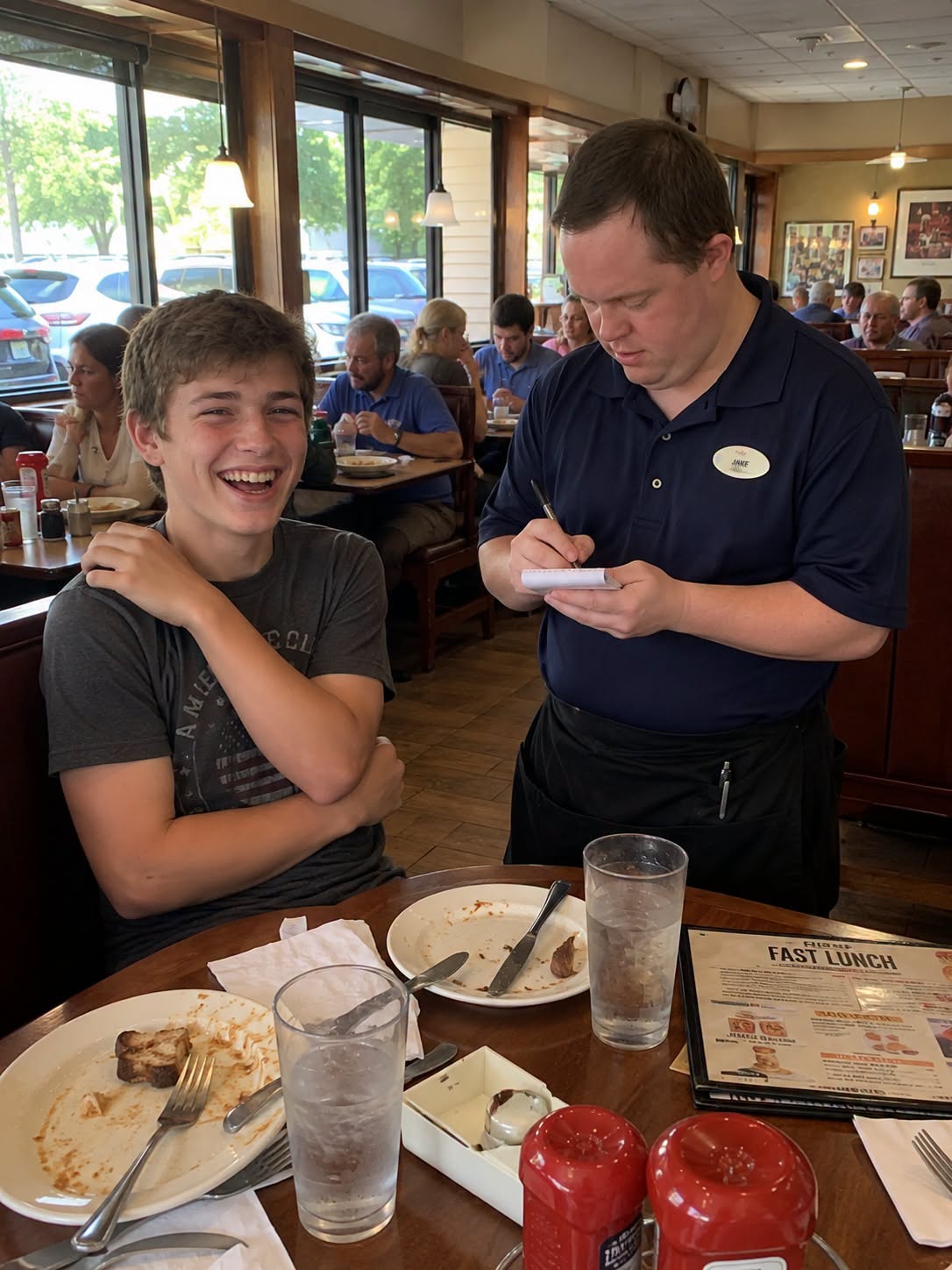
He was in his early twenties, I thought, with a careful quality about him, the particular care of someone who takes his work seriously and is making sure to do it right. He held his order pad with both hands. He greeted us with genuine warmth and asked about drinks and wrote down the order and read it back to us line by line to confirm he had it correct.
Leo was already smiling before Sam finished.
I knew what the smile was. I had spent fourteen years reading my son’s face and I knew the difference between his smiles, the genuine one and the performing one and the uncomfortable one and this one, which was the one that appeared when something had struck him as funny and he had not yet decided whether to express it.
I put my foot against his leg under the table.
He looked past me.
Sam moved into the specials and there was a word that was difficult, the way certain words are difficult for certain mouths, a word that required more from him than others, and he stopped and started it again from the beginning, slower this time, making sure he got it right.
Leo rolled his eyes.
The rolling of the eyes alone I could have addressed and moved past. But then he pulled his shoulders forward. Then he tilted his head. Just for a moment, just long enough for me to see it clearly, and his friend was getting a text at that moment with the same expression still on his face, the expression of someone who has found a joke and is sharing it.
Sam finished the specials.
He thanked us and went back toward the kitchen with the same care he had brought to the table.
I sat in the booth and I looked at my son and I could not find the boy who sat with lonely kids at parties anywhere in what I was seeing.
I did not make a scene.
I want to explain this choice because some people would say that making a scene was the correct response, that Sam deserved a public defense, that Leo deserved a public consequence. I do not disagree that Sam deserved to be defended. What I chose, instead of the public version, was the version that would produce something more than the immediate satisfaction of the defense. Making a scene at that table would have become, in Leo’s memory and in his telling of it to his friends, the story of the time his mom embarrassed him in public. The thing I was trying to produce was not embarrassment. It was understanding.
I put my credit card on the table.
I waited for Sam to come back and when he came back I apologized to him, quietly, not for anything specific, because naming what Leo had done in front of Sam would have required Sam to respond to it and Sam had not seen it and I did not want to make him a participant in what was between me and my son. I apologized in the way you apologize to someone when you owe them something you cannot fully account for, and I meant it, and he received it with a warmth that made me feel worse and better simultaneously.
The tip I left was the largest I have ever left in my life.
We walked to the parking lot in silence.
Leo waited until we were on the road.
“Mom, come on. I was just joking around. Why are you making such a huge deal out of this?”
I drove.
Twenty minutes home.
I did not answer him once, not because I was punishing him with silence but because I did not yet have the right words and I had learned from fourteen years of parenting Leo specifically that arriving at a conversation before I had the right words produced conversations that were about my feelings rather than about the thing I was trying to teach, which was a different conversation and one I could not afford to have by mistake.
He went for the stairs the moment we were through the door.
“Sit down at the kitchen table,” I said.
He turned.
He looked at me.
He sat.
I went to my bedroom and I went to the back of the closet, where there were boxes of things I kept because I had not yet decided what to do with them, the boxes that accumulate in every life and that you move from one closet to another without opening because opening them requires more than you have in the ordinary moments of an ordinary week.
The box I was looking for was wooden and had a faded quality to it that meant it had once been a more vivid color. It was not large. I had put it in that closet eight years ago and I had not opened it since and I knew exactly what was inside.
I brought it to the kitchen table.
I set it between us.
Leo looked at it.
I lifted the lid.
His smile was gone before he finished looking inside.
The box held photographs.
Some of them were printed, the older kind, the square format of the 1980s and early 1990s, and some were printed from digital files, the crisper image of later technology, and there were perhaps thirty photographs in the box in total, and they were all of the same person at different ages.
The person was my brother.
His name was Danny, and he had Down syndrome, and he had died when I was in my late twenties, eight years before Leo was born.
Leo had never met Danny.
He knew he had an uncle who died before he was born, because I had told him this as a fact when he was old enough to understand facts about family structure, but I had not told him much beyond that, not because I was protecting Danny’s memory from Leo specifically, but because grief has its own timeline and the grief for Danny had been something I carried in a particular way, the way you carry things that do not have a clean resolution, and I had not found the right moment to bring it forward.
Or I had told myself this.
It is possible that what I had been doing was not waiting for the right moment but avoiding the conversation that the right moment would require.
Leo looked at the photographs.
He looked at the one on top, which was a school photograph of Danny at about ten, the formal background and the good shirt and the specific quality of a school photograph in which a child is not performing anything, just being themselves for the camera.
“Who is this?” Leo said.
“Your uncle Danny,” I said.
Leo was quiet.
He picked up the photograph.
“Mom,” he said.
“He had Down syndrome,” I said. “Like our waiter tonight.”
Leo put the photograph down very carefully.
He looked at me.
“I didn’t know,” he said.
“There are a lot of things you don’t know,” I said. “About Danny. I’m going to tell you some of them.”
I sat down across from him.
I am going to try to tell you what I told Leo, not verbatim, because I did not speak in complete sentences and I do not have perfect memory, but in substance.
Danny was three years younger than me, which meant we had grown up together in the specific way that older and younger siblings grow up, with the whole range of that experience, the competition and the alliance and the particular love that forms when you are each other’s closest companion for the years when the world is very large and you are very small.
Danny was the funniest person I have ever known.
I told Leo this first because I thought it was the most important thing, because humor is one of the currencies of Leo’s life and I wanted him to understand that Danny operated in the same currency.
Danny had a particular relationship with timing. He understood, instinctively, the architecture of a joke, the setup and the beat and the landing, and he could execute it in a way that made you suspect he had been studying comedy professionally. He was also, like Leo, a reader, though the reading had come slowly for him, hard-won, and the joy he took in it was more visible than Leo’s because it had cost him more.
He had worked in a movie theater for eleven years, taking tickets and selling concessions with the specific pleasure of someone who loves films and is surrounded by people who love films. He knew the catalog of the theater by heart, which movies were showing in which auditorium and what time and which ones were worth seeing. He had opinions about films that were serious and specific and that he was not shy about expressing.
He had a best friend named Marcus, who did not have Down syndrome and who had met Danny at a community center when they were both teenagers and had been his friend for the rest of Danny’s life. They had watched every major sporting event together for twenty years, in the same seats on Marcus’s couch with the same snacks, and when Danny died Marcus was the person I called after my parents.
He had been loved completely.
This is the thing I wanted Leo to understand and this is the thing that is hardest to convey to a fourteen-year-old, the completeness of Danny’s life. Not despite his disability but as a life that included his disability as one of its conditions, the way all lives include their conditions, the specific circumstances that shape but do not define.
Danny had been made fun of.
I told Leo this too, and I told it clearly, without softening.
He had been made fun of in school and out of school and in the movie theater sometimes by the people who should have been grateful to him for helping them find their seats. The making fun of had taken many forms, some of them the kind that Leo had performed at the restaurant table, the imitation of his particular way of holding his head and his particular way of speaking, and some of them crueler than that.
“What did you do?” Leo said. “When people made fun of him?”
“When I was young,” I said, “I didn’t always do anything. Sometimes I was embarrassed. Sometimes I looked the other way.”
Leo was very still.
“I’m telling you this because I want you to understand that I know what I’m asking you to reckon with,” I said. “I have been where you were tonight. I have sat next to someone I loved and felt the particular discomfort of other people seeing him and responding to him with less than he deserved, and I have looked away. I have also sat next to him and watched someone make the face you made tonight, and felt what that feels like from the inside.”
I put the photographs on the table between us, spreading them.
Danny at ten in the school photo.
Danny at fifteen at a birthday party, laughing at something outside the frame with his whole body, the way he laughed.
Danny and me at my high school graduation, him standing beside me with the specific pride of a younger sibling at an older sibling’s milestone, his hand on my arm.
Danny and Marcus at what I recognized as a football game, both of them in team colors, both of them in mid-sentence to each other about something.
Danny at thirty, outside the movie theater where he worked, in his uniform, smiling the smile that was fully Danny, the one that contained no reservation.
Leo looked at each photograph.
“He looks happy,” Leo said.
“He was happy,” I said. “Genuinely. Not because his life was easy. Because he was himself, completely, and he was surrounded by people who knew that was enough.”
“How did he die?” Leo said.
“Heart problems,” I said. “People with Down syndrome have a higher risk for certain heart conditions. He was thirty-two.”
Leo was quiet.
“What was his name again?” Leo said.
“Daniel,” I said. “Danny.”
He looked at the photograph from the movie theater.
“Did he know?” Leo said. “When people made fun of him?”
“Sometimes,” I said. “Not always. He was better at some social cues than others. When he didn’t know, I was grateful he didn’t know. When he did know, I watched him handle it in a way I could never fully explain, just absorb it and keep going, keep being himself, and I was in awe of him for that even when I was too young to say so.”
“How come you never told me about him?” Leo said.
I sat with this question.
“I’ve been asking myself that for about forty minutes,” I said.
“And?”
“Because grief is complicated,” I said. “Because I kept thinking I would find the right moment and the right moment kept not being now. And because I think I was also protecting myself a little bit from the conversation this would require.”
“This conversation,” Leo said.
“Yes,” I said.
“Because you knew it would require talking about tonight,” he said.
“I didn’t know tonight was going to happen,” I said. “But I knew that bringing Danny into your life fully would eventually require talking about the way people respond to people like him, and I knew that conversation would be uncomfortable for both of us.”
He looked at the photographs.
“I didn’t know,” he said. “About Danny.”
“I know,” I said.
“That doesn’t make what I did okay,” he said.
I looked at my son.
He had gotten there himself, which was the thing I had been hoping for and had not known whether to expect.
“No,” I said. “It doesn’t. But it matters that you said it.”
“Would it have been different?” he said. “If I’d known. Would I not have done it?”
This was a better question than I had expected from a fourteen-year-old in the middle of a difficult conversation, the question underneath the surface question, which was whether knowing changes behavior or whether behavior has to change for different reasons.
“I don’t know,” I said honestly. “I hope so. But I think the goal is for it not to matter whether you know. I think the goal is to be the kind of person who doesn’t do that regardless of whether there’s a Danny in your life.”
“The kind of person you want me to be,” he said.
“The kind of person I think you actually are,” I said. “Which is why tonight was such a surprise.”
He was quiet.
“I was showing off,” he said. “For Marcus. The text.”
“I know,” I said.
“It was stupid,” he said.
“It was,” I said.
“I feel sick about it,” he said.
“Good,” I said. “Not because I want you to feel bad about yourself. But because feeling sick about it means you understand what it was.”
He picked up the photograph from the movie theater.
“He looks like he loved his job,” Leo said.
“He loved it more than I’ve loved anything in my professional life,” I said. “He talked about movies the way you talk about books.”
Leo looked at the photograph.
“Sam,” he said. “The waiter. He was like that. You could tell. He cared about doing it right.”
“Yes,” I said.
“He was reading the specials back, trying to make sure he got it right,” Leo said. “And I was texting my friend about how funny it was that he was trying to get it right.”
He set the photograph down.
He put his face in his hands.
He was not crying but he was close to it and he was deciding whether to be close to it or to pull back, the specific negotiation of a fourteen-year-old boy with his emotions in front of his mother.
I let him negotiate it without helping him.
“I think,” he said finally, “I need to apologize to him.”
“To Sam,” I said.
“Yes,” he said. “Is that possible? Can I go back?”
I thought about this.
“I think that’s possible,” I said. “I’ll call the restaurant tomorrow and explain the situation and see if Sam would be willing to receive an apology.”
“You’d do that with me?” he said.
“We’d do it together,” I said.
He nodded.
“What if he doesn’t want to see me?” Leo said.
“Then we respect that,” I said. “An apology is for the person being apologized to, not for the person apologizing. If Sam doesn’t want to receive it, that’s his right and we honor it.”
“And if he does?” Leo said.
“Then you tell him the truth,” I said. “Not the full story. He doesn’t need the full story. But you tell him what you did was wrong and that you’re sorry.”
“Without making it about me,” Leo said.
“Without making it about you,” I said.
He was quiet for a moment.
“Can I look at these?” he said, gesturing at the photographs.
“Yes,” I said.
He went through them slowly, picking each one up and looking at it before setting it down, in the careful way he handled things that mattered to him.
“He really was funny,” Leo said, looking at one of them.
“Which one?” I said.
“This one,” he said. He held up the photograph from the birthday party, the one where Danny was laughing at something outside the frame.
“He laughed like that for real,” I said. “With his whole body.”
“What was funny?” Leo said.
“I don’t remember,” I said. “Something his friend Marcus said, probably. Marcus always made him laugh.”
“Marcus,” Leo said. “Like my friend Marcus.”
“Yes,” I said. “Danny’s Marcus was different. He had known Danny since they were both teenagers. He gave the eulogy at Danny’s funeral.”
“What did he say?” Leo said.
I thought about Marcus at the lectern, forty-one years old and holding a single piece of paper that he had written on both sides.
“He said Danny made him better at being a person,” I said. “He said he had known Danny for twenty-five years and in that time he had watched Danny navigate things that would have made Marcus give up, and do it with a specific combination of stubbornness and grace that he had never seen in anyone else. He said he was embarrassed by how much he had learned from someone people mostly pitied, and that the embarrassment was good because it meant he had been paying attention.”
Leo was looking at the photograph.
“Twenty-five years,” he said.
“They met when they were fifteen,” I said. “Danny died at thirty-two. They were best friends for seventeen years, and then Marcus kept being his friend after he died, which is a thing that is possible to do.”
The steakhouse was his idea, specifically.
He had been asking about it since April, when his friend Marcus had been taken there for his birthday and had described it with the reverence of someone reporting from a better world. Leo had a history with good restaurants, not the fancy kind but the kind where the food was taken seriously, where you could tell that what was on the plate mattered to the people who made it, and he was the child who read menus carefully and asked questions about preparation with the same seriousness he brought to books.
The report card had been worth celebrating.
He had a learning difference, Leo, a processing challenge that had made reading slow for him in the early years despite loving books fiercely, and the work he had put into the school year just finished had produced results that were genuinely his, not the results of accommodations or of teachers adjusting the bar downward, but of a boy who had worked harder than most of his classmates and achieved something real with that work.
I was proud of him in the specific way that pride works when someone you love has earned something.
We drove to the restaurant on a Friday evening in June, the particular warm and long-lit evening that makes everything feel like the right kind of occasion, and Leo was in the passenger seat doing the thing he did when he was in a good mood, which was narrating the world outside the window with a running commentary that was too quiet to fully hear but that I could catch phrases of and that always made me smile.
We were shown to a table.
The restaurant was the kind that took its food seriously but was not precious about it, the kind of place where people were there to eat and the eating was good, with the low light and the leather booths that had the quality of somewhere that had been there long enough to mean something.
Sam came to our table.
He was in his early twenties, I thought, with a careful quality about him, the particular care of someone who takes his work seriously and is making sure to do it right. He held his order pad with both hands. He greeted us with genuine warmth and asked about drinks and wrote down the order and read it back to us line by line to confirm he had it correct.
Leo was already smiling before Sam finished.
I knew what the smile was. I had spent fourteen years reading my son’s face and I knew the difference between his smiles, the genuine one and the performing one and the uncomfortable one and this one, which was the one that appeared when something had struck him as funny and he had not yet decided whether to express it.
I put my foot against his leg under the table.
He looked past me.
Sam moved into the specials and there was a word that was difficult, the way certain words are difficult for certain mouths, a word that required more from him than others, and he stopped and started it again from the beginning, slower this time, making sure he got it right.
Leo rolled his eyes.
The rolling of the eyes alone I could have addressed and moved past. But then he pulled his shoulders forward. Then he tilted his head. Just for a moment, just long enough for me to see it clearly, and his friend was getting a text at that moment with the same expression still on his face, the expression of someone who has found a joke and is sharing it.
Sam finished the specials.
He thanked us and went back toward the kitchen with the same care he had brought to the table.
I sat in the booth and I looked at my son and I could not find the boy who sat with lonely kids at parties anywhere in what I was seeing.
I did not make a scene.
I want to explain this choice because some people would say that making a scene was the correct response, that Sam deserved a public defense, that Leo deserved a public consequence. I do not disagree that Sam deserved to be defended. What I chose, instead of the public version, was the version that would produce something more than the immediate satisfaction of the defense. Making a scene at that table would have become, in Leo’s memory and in his telling of it to his friends, the story of the time his mom embarrassed him in public. The thing I was trying to produce was not embarrassment. It was understanding.
I put my credit card on the table.
I waited for Sam to come back and when he came back I apologized to him, quietly, not for anything specific, because naming what Leo had done in front of Sam would have required Sam to respond to it and Sam had not seen it and I did not want to make him a participant in what was between me and my son. I apologized in the way you apologize to someone when you owe them something you cannot fully account for, and I meant it, and he received it with a warmth that made me feel worse and better simultaneously.
The tip I left was the largest I have ever left in my life.
We walked to the parking lot in silence.
Leo waited until we were on the road.
“Mom, come on. I was just joking around. Why are you making such a huge deal out of this?”
I drove.
Twenty minutes home.
I did not answer him once, not because I was punishing him with silence but because I did not yet have the right words and I had learned from fourteen years of parenting Leo specifically that arriving at a conversation before I had the right words produced conversations that were about my feelings rather than about the thing I was trying to teach, which was a different conversation and one I could not afford to have by mistake.
He went for the stairs the moment we were through the door.
“Sit down at the kitchen table,” I said.
He turned.
He looked at me.
He sat.
I went to my bedroom and I went to the back of the closet, where there were boxes of things I kept because I had not yet decided what to do with them, the boxes that accumulate in every life and that you move from one closet to another without opening because opening them requires more than you have in the ordinary moments of an ordinary week.
The box I was looking for was wooden and had a faded quality to it that meant it had once been a more vivid color. It was not large. I had put it in that closet eight years ago and I had not opened it since and I knew exactly what was inside.
I brought it to the kitchen table.
I set it between us.
Leo looked at it.
I lifted the lid.
His smile was gone before he finished looking inside.
The box held photographs.
Some of them were printed, the older kind, the square format of the 1980s and early 1990s, and some were printed from digital files, the crisper image of later technology, and there were perhaps thirty photographs in the box in total, and they were all of the same person at different ages.
The person was my brother.
His name was Danny, and he had Down syndrome, and he had died when I was in my late twenties, eight years before Leo was born.
Leo had never met Danny.
He knew he had an uncle who died before he was born, because I had told him this as a fact when he was old enough to understand facts about family structure, but I had not told him much beyond that, not because I was protecting Danny’s memory from Leo specifically, but because grief has its own timeline and the grief for Danny had been something I carried in a particular way, the way you carry things that do not have a clean resolution, and I had not found the right moment to bring it forward.
Or I had told myself this.
It is possible that what I had been doing was not waiting for the right moment but avoiding the conversation that the right moment would require.
Leo looked at the photographs.
He looked at the one on top, which was a school photograph of Danny at about ten, the formal background and the good shirt and the specific quality of a school photograph in which a child is not performing anything, just being themselves for the camera.
“Who is this?” Leo said.
“Your uncle Danny,” I said.
Leo was quiet.
He picked up the photograph.
“Mom,” he said.
“He had Down syndrome,” I said. “Like our waiter tonight.”
Leo put the photograph down very carefully.
He looked at me.
“I didn’t know,” he said.
“There are a lot of things you don’t know,” I said. “About Danny. I’m going to tell you some of them.”
I sat down across from him.
I am going to try to tell you what I told Leo, not verbatim, because I did not speak in complete sentences and I do not have perfect memory, but in substance.
Danny was three years younger than me, which meant we had grown up together in the specific way that older and younger siblings grow up, with the whole range of that experience, the competition and the alliance and the particular love that forms when you are each other’s closest companion for the years when the world is very large and you are very small.
Danny was the funniest person I have ever known.
I told Leo this first because I thought it was the most important thing, because humor is one of the currencies of Leo’s life and I wanted him to understand that Danny operated in the same currency.
Danny had a particular relationship with timing. He understood, instinctively, the architecture of a joke, the setup and the beat and the landing, and he could execute it in a way that made you suspect he had been studying comedy professionally. He was also, like Leo, a reader, though the reading had come slowly for him, hard-won, and the joy he took in it was more visible than Leo’s because it had cost him more.
He had worked in a movie theater for eleven years, taking tickets and selling concessions with the specific pleasure of someone who loves films and is surrounded by people who love films. He knew the catalog of the theater by heart, which movies were showing in which auditorium and what time and which ones were worth seeing. He had opinions about films that were serious and specific and that he was not shy about expressing.
He had a best friend named Marcus, who did not have Down syndrome and who had met Danny at a community center when they were both teenagers and had been his friend for the rest of Danny’s life. They had watched every major sporting event together for twenty years, in the same seats on Marcus’s couch with the same snacks, and when Danny died Marcus was the person I called after my parents.
He had been loved completely.
This is the thing I wanted Leo to understand and this is the thing that is hardest to convey to a fourteen-year-old, the completeness of Danny’s life. Not despite his disability but as a life that included his disability as one of its conditions, the way all lives include their conditions, the specific circumstances that shape but do not define.
Danny had been made fun of.
I told Leo this too, and I told it clearly, without softening.
He had been made fun of in school and out of school and in the movie theater sometimes by the people who should have been grateful to him for helping them find their seats. The making fun of had taken many forms, some of them the kind that Leo had performed at the restaurant table, the imitation of his particular way of holding his head and his particular way of speaking, and some of them crueler than that.
“What did you do?” Leo said. “When people made fun of him?”
“When I was young,” I said, “I didn’t always do anything. Sometimes I was embarrassed. Sometimes I looked the other way.”
Leo was very still.
“I’m telling you this because I want you to understand that I know what I’m asking you to reckon with,” I said. “I have been where you were tonight. I have sat next to someone I loved and felt the particular discomfort of other people seeing him and responding to him with less than he deserved, and I have looked away. I have also sat next to him and watched someone make the face you made tonight, and felt what that feels like from the inside.”
I put the photographs on the table between us, spreading them.
Danny at ten in the school photo.
Danny at fifteen at a birthday party, laughing at something outside the frame with his whole body, the way he laughed.
Danny and me at my high school graduation, him standing beside me with the specific pride of a younger sibling at an older sibling’s milestone, his hand on my arm.
Danny and Marcus at what I recognized as a football game, both of them in team colors, both of them in mid-sentence to each other about something.
Danny at thirty, outside the movie theater where he worked, in his uniform, smiling the smile that was fully Danny, the one that contained no reservation.
Leo looked at each photograph.
“He looks happy,” Leo said.
“He was happy,” I said. “Genuinely. Not because his life was easy. Because he was himself, completely, and he was surrounded by people who knew that was enough.”
“How did he die?” Leo said.
“Heart problems,” I said. “People with Down syndrome have a higher risk for certain heart conditions. He was thirty-two.”
Leo was quiet.
“What was his name again?” Leo said.
“Daniel,” I said. “Danny.”
He looked at the photograph from the movie theater.
“Did he know?” Leo said. “When people made fun of him?”
“Sometimes,” I said. “Not always. He was better at some social cues than others. When he didn’t know, I was grateful he didn’t know. When he did know, I watched him handle it in a way I could never fully explain, just absorb it and keep going, keep being himself, and I was in awe of him for that even when I was too young to say so.”
“How come you never told me about him?” Leo said.
I sat with this question.
“I’ve been asking myself that for about forty minutes,” I said.
“And?”
“Because grief is complicated,” I said. “Because I kept thinking I would find the right moment and the right moment kept not being now. And because I think I was also protecting myself a little bit from the conversation this would require.”
“This conversation,” Leo said.
“Yes,” I said.
“Because you knew it would require talking about tonight,” he said.
“I didn’t know tonight was going to happen,” I said. “But I knew that bringing Danny into your life fully would eventually require talking about the way people respond to people like him, and I knew that conversation would be uncomfortable for both of us.”
He looked at the photographs.
“I didn’t know,” he said. “About Danny.”
“I know,” I said.
“That doesn’t make what I did okay,” he said.
I looked at my son.
He had gotten there himself, which was the thing I had been hoping for and had not known whether to expect.
“No,” I said. “It doesn’t. But it matters that you said it.”
“Would it have been different?” he said. “If I’d known. Would I not have done it?”
This was a better question than I had expected from a fourteen-year-old in the middle of a difficult conversation, the question underneath the surface question, which was whether knowing changes behavior or whether behavior has to change for different reasons.
“I don’t know,” I said honestly. “I hope so. But I think the goal is for it not to matter whether you know. I think the goal is to be the kind of person who doesn’t do that regardless of whether there’s a Danny in your life.”
“The kind of person you want me to be,” he said.
“The kind of person I think you actually are,” I said. “Which is why tonight was such a surprise.”
He was quiet.
“I was showing off,” he said. “For Marcus. The text.”
“I know,” I said.
“It was stupid,” he said.
“It was,” I said.
“I feel sick about it,” he said.
“Good,” I said. “Not because I want you to feel bad about yourself. But because feeling sick about it means you understand what it was.”
He picked up the photograph from the movie theater.
“He looks like he loved his job,” Leo said.
“He loved it more than I’ve loved anything in my professional life,” I said. “He talked about movies the way you talk about books.”
Leo looked at the photograph.
“Sam,” he said. “The waiter. He was like that. You could tell. He cared about doing it right.”
“Yes,” I said.
“He was reading the specials back, trying to make sure he got it right,” Leo said. “And I was texting my friend about how funny it was that he was trying to get it right.”
He set the photograph down.
He put his face in his hands.
He was not crying but he was close to it and he was deciding whether to be close to it or to pull back, the specific negotiation of a fourteen-year-old boy with his emotions in front of his mother.
I let him negotiate it without helping him.
“I think,” he said finally, “I need to apologize to him.”
“To Sam,” I said.
“Yes,” he said. “Is that possible? Can I go back?”
I thought about this.
“I think that’s possible,” I said. “I’ll call the restaurant tomorrow and explain the situation and see if Sam would be willing to receive an apology.”
“You’d do that with me?” he said.
“We’d do it together,” I said.
He nodded.
“What if he doesn’t want to see me?” Leo said.
“Then we respect that,” I said. “An apology is for the person being apologized to, not for the person apologizing. If Sam doesn’t want to receive it, that’s his right and we honor it.”
“And if he does?” Leo said.
“Then you tell him the truth,” I said. “Not the full story. He doesn’t need the full story. But you tell him what you did was wrong and that you’re sorry.”
“Without making it about me,” Leo said.
“Without making it about you,” I said.
He was quiet for a moment.
“Can I look at these?” he said, gesturing at the photographs.
“Yes,” I said.
He went through them slowly, picking each one up and looking at it before setting it down, in the careful way he handled things that mattered to him.
“He really was funny,” Leo said, looking at one of them.
“Which one?” I said.
“This one,” he said. He held up the photograph from the birthday party, the one where Danny was laughing at something outside the frame.
“He laughed like that for real,” I said. “With his whole body.”
“What was funny?” Leo said.
“I don’t remember,” I said. “Something his friend Marcus said, probably. Marcus always made him laugh.”
“Marcus,” Leo said. “Like my friend Marcus.”
“Yes,” I said. “Danny’s Marcus was different. He had known Danny since they were both teenagers. He gave the eulogy at Danny’s funeral.”
“What did he say?” Leo said.
I thought about Marcus at the lectern, forty-one years old and holding a single piece of paper that he had written on both sides.
“He said Danny made him better at being a person,” I said. “He said he had known Danny for twenty-five years and in that time he had watched Danny navigate things that would have made Marcus give up, and do it with a specific combination of stubbornness and grace that he had never seen in anyone else. He said he was embarrassed by how much he had learned from someone people mostly pitied, and that the embarrassment was good because it meant he had been paying attention.”
Leo was looking at the photograph.
“Twenty-five years,” he said.
“They met when they were fifteen,” I said. “Danny died at thirty-two. They were best friends for seventeen years, and then Marcus kept being his friend after he died, which is a thing that is possible to do.”