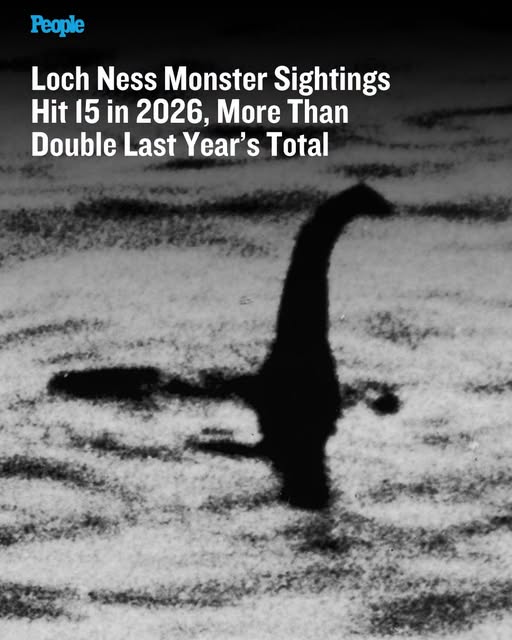
Loch Ness Monster Sightings Hit 15 in 2026, More Than Double Last Year’s Total
The polarizing legacy lives on with enthusiasts and researchers finding unique, logical and even philosophical explanations for the elusive creature
- The latest Nessie sighting came from a German visitor who described a 20-foot black object near the water’s surface
- DNA testing found no plesiosaur evidence in Loch Ness; some think the sightings could be giant eels
- Loch Ness Monster legend generates an estimated $55 million in annual tourism revenue for the region
-
Nessie is having a big year, only adding to the legacy of the elusive cryptid.
The offficial has accepted 15 on-site reports so far in 2026, more than double the six logged in all of 2025. According to Media the register has recorded 1,180 sightings at the Scottish loch across decades, plus 17 webcam images.
The most recent accepted report came from Felix Tiekemeier, a visitor from Germany. Just before noon on Friday, Aug. 21, he spotted something about 20 feet long about 984 feet from shore.
“He said that the object was black and surfaced, remained at the water’s surface for about 20 seconds, and then disappeared again,” the register stated, adding that he “explained that it was swimming close to the surface and appeared to have a head.
- Earlier in August, Jocelyn Boyce, visiting from Barcelona, said she and her family saw “a dark, almost black, mound-like shape protruding above the surface of the water” from a viewpoint at Urquhart Castle
-
A day before that, Norbert Kawka of Malta told the register he watched something move against the current near Fort Augustus for 15 minutes, dipping in and out of the water like “a very large eel.”
Ironically, the comparison may be apt. In 2019, researchers led by New Zealand’s University of Otago sampled DNA from the loch’s water. They found no evidence of a plesiosaur, a prehistoric marine reptile often linked to Nessie lore, as the Courier reported. However, they tested in the loch.
“Our data doesn’t reveal their size, but the sheer quantity of the material says that we can’t discount the possibility that there may be giant eels in Loch Ness,” geneticist Neil Gemmell said at the time