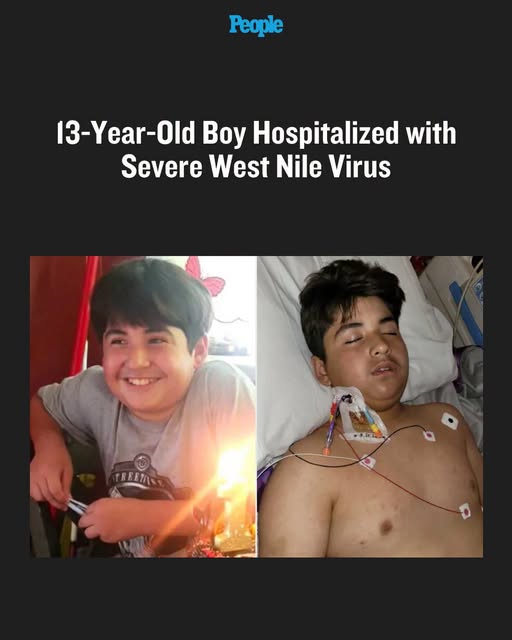
13-Year-Old Boy Hospitalized with Severe West Nile Virus
Joseph Vasquez lost mobility in his legs after contracting the mosquito-borne disease
- Joseph Vasquez developed transverse myelitis, a rare spinal cord inflammation linked to complications from the mosquito-borne virus
- The Long Beach teen has lost mobility in his legs and doctors are unsure whether he will recover
- The CDC has reported 987 West Nile cases across 43 states this year, including 750 severe infections
-
A teenage boy has been hospitalized after contracting the West Nile virus, a mosquito-borne disease which has no cure.
For three weeks, Joseph Vasquez — a 13-year-old from Long Beach, Calif. — has been bedridden at Los Angeles Children’s Hospital. His health troubles began when he started experiencing a full-body rash. He quickly developed other symptoms like fever, headaches, loss of appetite and eventually pain in his legs and loss of balance.
Vasquez’s mother, Maria Salazar, said that she finally took him to the hospital after he suffered a fall at school.
“We ended up taking him to the emergency room because I found him facedown on the ground,” she told NBC Los Angeles. “It just started to be from the lower body, and then he couldn’t even feel his toes or movement.”
-
Shortly after, Vasquez was diagnosed with transverse myelitis, a rare neurological disorder caused by inflammation of the spinal cord, according to the Cleveland Clinic. It leads to symptoms like severe pain, bladder dysfunction and muscle weakness that can develop into paralysis.
Doctors said the condition was caused by a complication of West Nile virus, which he contracted from a mosquito bite.
“I was fearful that my son could pass away,” Salazar said. “It’s scary because I’m just trying to be supportive for him. He doesn’t understand what’s really going on and I’m just trying to give him high hopes.”
Vasquez has since lost all mobility in his legs. According to a GoFundMe created for his recovery, the teen also deals with severe nerve pain from his lower back to his feet, a stiff neck, and loss of bladder and bowel control. Doctors are unsure if he’ll regain his mobility, and say he could spend additional weeks or even months in the hospital.
Never miss a story — sign up for PEOPLE’s free daily newsletter to stay up-to-date on the best of what PEOPLE has to offer, from celebrity news to compelling human interest stories.
“For him to be active outside playing to now bedridden. It takes a toll on him,” his mother told KTLA5. “It’s just scary because you can just walk in, randomly get bit by a mosquito and you can end up being in the hospital like my son.”
Salazar admitted that she initially brushed off his symptoms, assuming her son had a common cold. She’s now urging parents to pay more attention to early signs and take proper precautions.
“They should be looking out for any mosquito bites, dizziness, headaches, blurry vision, falling, losing balance,” she said. “If your kids are telling you, ‘Hey, my head hurts,’ and they’re scratching, take them to the doctor.”
-
West Nile is a virus spread by mosquitoes. Most people won’t show symptoms. For those who do show symptoms — about 1 in 5 people — it causes flu-like symptoms (vomiting, diarrhea, headaches, body aches, joint pains), according to the CDC. Fatigue and weakness can linger for months.
In severe cases, the virus affects the central nervous system, causing encephalitis (inflammation of the brain) or meningitis (inflammation of the membrane around the brain and spinal cords). The virus causes high fever, paralysis, vision loss and coma, and can be fatal.
-
There is no treatment and no vaccine for West Nile. Instead, officials urge prevention. The CDC recommends wearing loose-fitting clothing that makes it harder for mosquitoes to bite through the fabric, and to avoid being outside between dusk and dawn, when the mosquitoes are more likely to bite.
The agency also advises using insect repellent that contains DEET, Picaridin, IR3535, oil of lemon eucalyptus, or para-menthane-diol, but notes the last two ingredients are not recommended for children under the age of 3.
As of Sept. 29, there have been 987 cases of West Nile virus this year across 43 states, including 750 severe cases, the CDC reports.
- LEAVE A COMMENT