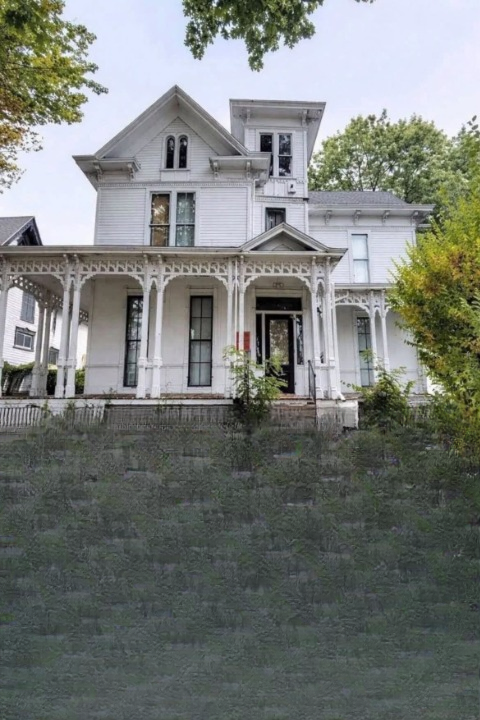
Hidden beneath years of weathering and overgrown landscaping is a remarkable Victorian home that still retains many of the architectural details that made homes from its era so distinctive. From its dramatic tower and steep gables to its expansive wrap-around porch, the residence has the kind of character that is difficult to reproduce in modern…
construction. Although the property appears to be in need of significant attention, its original design offers an intriguing starting point for a restoration project
A Striking Victorian Exterior
The home reflects the elaborate architectural style associated with 19th-century Victorian residences
One of its most noticeable features is the prominent tower, which rises above the main structure and gives the house an impressive silhouette. Multiple gabled roof sections further emphasize the home’s height and create a layered appearance.
The exterior is dominated by a large wrap-around porch.
Decorative woodwork runs throughout the porch, including detailed fretwork, slender spindles, and ornamental brackets. These elements demonstrate the craftsmanship that went into many historic homes, when decorative architectural details were often created by hand.
The porch also gives the residence a welcoming outdoor gathering space while adding considerable character to the front facade.
An Elevated Entrance
From the street, a set of concrete steps leads toward the raised porch.
The front yard currently appears h
eavily overgrown, with vegetation covering portions of the landscape. While the lack of maintenance makes the property look somewhat forgotten, the underlying structure remains visually impressive.
With professional landscaping and appropriate exterior work, the relationship between the house, porch, and front yard could potentially be transformed.
The elevated porch also contributes to the home’s traditional Victorian appearance, creating a formal transition between the yard and main entrance.
Tall Windows Bring Character
Another defining feature is the home’s collection of tall, narrow double-hung windows.
Together, the windows and entrance create a balanced facade with strong vertical lines.
Signs of Time and Weather
The property clearly shows the effects of age.
The wooden siding has weathered over time, while the landscaping appears to have received limited maintenance. Before any restoration work could begin, a thorough professional assessment would be important to determine the condition of the structure, roof, exterior materials, windows, foundation, and interior systems.
Older homes can require specialized repairs, particularly when original woodwork and decorative features are involved.
Yet the visible signs of aging don’t completely hide the home’s original personality.
Many of its most recognizable architectural elements remain in place.
A Potential Restoration Project
For someone passionate about historic architecture, the property could offer an opportunity to preserve and restore an important piece of residential history.
A restoration would likely involve much more than simply applying a new coat of paint.
Exterior woodwork may need careful repair, damaged areas may need to be reconstructed, and the windows could require professional restoration or replacement depending on their condition.
The surrounding landscaping would also benefit from clearing, trimming, and thoughtful redesign.
Inside, a complete inspection would be necessary to determine the condition of the plumbing, electrical system, heating, roofing, foundation, and other essential components.
The goal of a successful restoration would be to improve the home’s condition while retaining the architectural details that give it its identity.
Why Victorian Homes Remain Appealing
Part of the attraction of historic Victorian properties is their individuality.
Modern homes are often designed around efficiency and simplicity, while Victorian residences frequently feature elaborate details, unusual rooflines, decorative trim, large porches, and distinctive windows.
No two historic properties are necessarily identical.
Features such as the tower, ornate porch, fretwork, brackets, and tall windows can give a home a personality all its own.
For preservation enthusiasts, those details are often just as important as the building’s basic structure.
Seeing Beyond the Overgrowth
The current condition of the yard can make it difficult to appreciate the property at first glance.
But underneath the overgrown vegetation is a home with an unusually strong architectural presence.
The wrap-around porch remains one of its most prominent features. The tower creates a memorable profile, while the gabled roof sections and vertical windows reinforce the historic character.
With the right combination of professional repairs, careful preservation, and landscaping, the property could potentially look dramatically different.
Of course, anyone considering a restoration would need to research local requirements, possible historic-designation rules, renovation costs, and the condition of the structure before moving forward.
A Chance to Preserve the Past
Restoring an old Victorian house is more than a typical renovation project.
It can mean preserving craftsmanship, architectural traditions, and a physical connection to an earlier period.
This particular home may currently need substantial work, but its surviving details provide a strong foundation for imagining what it could become.
The house doesn’t need to lose its age to regain its beauty.
With thoughtful restoration, its weathered wood, decorative porch, distinctive tower, and historic proportions could once again become the features that make it stand out.
For someone willing to take on the challenge, this forgotten Victorian may not simply be an old house waiting for repairs.
It could be a piece of architectural history waiting for its next chapter.
Leave a Reply